Categories: C-N Bond Formation >
Synthesis of hydroxamates (Weinreb amides)
| Related |  |
Recent Literature

Weinreb amides can be prepared directly from carboxylic acids and N,O-dimethylhydroxylamine
in the presence of phosphorus trichloride at 60°C in toluene without separation
of the moisture and air sensitive intermediate P[NMe(OMe)]3. Various
functional groups are tolerated and even sterically hindered carboxylic acids
give the corresponding Weinreb amides in excellent yields. The method is
suitable for large-scale production.
T. Niu, K.-H. Wang, D. Huang, C. Xu, Y, Su, Y. Hu, Y. Fu, Synthesis, 2014, 46,
320-330.

P[NCH3(OCH3)]3 is a powerful reagent for
conversion of aromatic and aliphatic carboxylic acids, including sterically
hindered substrates, directly to Weinreb amides in excellent yields in toluene
as solvent.
T. Niu, W. Zhang, D. Huang, C. Xu, H. Wang, Y. Hu, Org. Lett., 2009,
11, 4474-4477.

A reaction of unactivated carboxylic acids with masked O-substituted
isocyanates provides hydroxamates. This method offers broad functional group
tolerance.
J. S. Derasp, E. A. Barbera, N. R. Séguin, D. D. Brzezinski, A. M. Beauchemin,
Org. Lett., 2020, 22, 7403-7407.

Hydroxamic acids were synthesized from carboxylic acids and hydroxylamine
hydrochloride in the presence of ethyl
2-cyano-2-(4-nitrophenylsulfonyloxyimino)acetate (4-NBsOXY). 4-NBsOXY also promotes the Lossen rearrangement of hydroxamic acids in the presence of amines
to yield ureas. The reactions are compatible with common N- and O-protecting
groups and prevent racemization.
K. Thalluri, S. R. Manne, D. Dev, B. Mandal, J. Org. Chem., 2014,
79, 3765-3775.

The coupling reagent ethyl 2-cyano-2-(2-nitrobenzenesulfonyloxyimino)acetate (o-NosylOXY)
produces only byproducts that can be easily recovered and reused for the
synthesis of the same reagent, making coupling reactions to yield amides,
hydroxamates, peptides, and esters more environmentally friendly and
cost-effective.
D. Dev, N. B. Palakurthy, K. Thalluri, J. Chandra, B. Mandal, J. Org. Chem., 2014,
79, 5420-5431.

A continuous flow tubing reactor can be used to readily transform methyl or
ethyl carboxylic esters into the corresponding hydroxamic acids. Flow rate,
reactor volume, and temperature were optimized for increased reaction rate and
higher product purity.
E. Riva, S. Gagliardi, C. Mazzoni, D. Passarella, A. Rencurosi, D. Vigo, M.
Martinelli, J. Org. Chem., 2009,
74, 3540-3543.

The reaction of esters with hydroxylamine in the presence of a base under
microwave activation provides hydroxamic acids in good yields and purity. The
method has been successfully applied to enantiomerically pure esters without
loss of stereochemical integrity.
A. Massaro, A. Mordini, G. Reginato, F. Russo, M. Taddei, Synthesis, 2007,
3201-3204.

1-Propanephosphonic acid cyclic anhydride (T3P) promotes the synthesis of
hydroxamic acids from carboxylic acids. Application of ultrasonication
accelerates this conversion. Further, T3P has also been employed to activate the
hydroxamates, leading to isocyanates via Lossen rearrangement. Trapping with
suitable nucleophiles affords the corresponding ureas and carbamates.
B. Vasantha, H. P. Hemantha, V. V. Sureshbabu, Synthesis, 2010,
2990-2996.
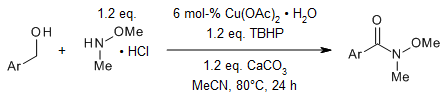
The use of tert-butyl hydroperoxide as an oxidant and an inexpensive and
air stable copper catalyst enables a simple and efficient protocol for the
oxidative amidation of commercially affordable alcohols to Weinreb amides in
very good yields. The reaction tolerates various functional groups.
S. L. Yedage, B. M. Bhanage, Synthesis, 2015, 47,
526-532.

NHC-catalyzed direct amidation of a variety of aryl, alkyl, alkenyl, and
heterocyclic aldehydes with nitroso compounds is a powerful method for the
synthesis of N-arylhydroxamic acids in excellent yields. This chemistry
was also extended to a three-component reaction for the synthesis of N-arylaziridines.
F. T. Wong, P. K. Patra, J. Seayad, Y. Zhang, J. Y. Ying, Org. Lett., 2008,
10, 2333-2336.

Imidazole carbamates and ureas are chemoselective esterification and amidation
reagents. A simple synthetic procedure allows the conversion of a wide variety
of carboxylic acids to ester or amide analogues in high yields.
S. T. Heller, R. Sarpong, Org. Lett., 2010,
12, 4572-4575.

A convenient and simple one-flask method for the preparation of Weinreb
amides, hydroxamates and hydroxamic acids even in large scale is described.
L. De Luca, G. Giacomelli, M. Taddei, J. Org. Chem., 2001, 66, 2534-2537.

Deoxo-Fluor is a versatile and
mild reagent for acyl fluoride generation and subsequent one-flask amide
coupling. The conversion of acids to amides and Weinreb amides and the use
of Deoxo-Fluor as peptide-coupling reagent have been explored. Products were
isolated after facile purification in good yields.
J. M. White, A. R. Tunoori, B. J. Turunen, G. I.
Georg, J. Org. Chem., 2004, 69, 2573-2576.

Carboxylic acids were conveniently converted into unsubstituted, N-alkyl-,
O-alkyl-, and O,N-dialkylhydroxamic acids via
acylbenzotriazole intermediates. The ready availability of the reagents,
mild conditions, and easy handling of the intermediates are advantageous.
A. R. Katritzky, N. Kirichenko, B. V. Rogovoy, Synthesis,
2003, 2777-2780.

A simple and high-yielding one-step method for the synthesis
of hydroxamates from various unactivated esters (including
enolizable esters and chiral α-amino acid esters and peptides) has been
developed.
A. Gissot, A. Volonterio, M. Zanda, J. Org. Chem., 2005,
70, 6925-6928.

Sterically hindered carboxylic acids can be efficiently converted
to N-methoxy-N-methyl amides with 1.1 equiv of
methanesulfonyl chloride, 3 equiv of triethylamine, and 1.1 equiv of
N-methoxy-N-methylamine in good yields. The
major byproduct in these reactions, N-methoxy-N-methylmethanesulfonamide, can be
removed under vacuum for 14-24 h.
J. C. S. Woo, E. Fenster, G. R. Dake, J. Org. Chem.,
2004,
69, 8984-8986.

A Pd-catalyzed aminocarbonylation of aryl bromides into the corresponding
Weinreb amides at atmospheric pressure efficiently transforms
eletron-deficient, - neutral, and -rich aryl bromides.
J. R. Martinelli, D. M. M. Freckmann, S. L. Buchwald, Org. Lett.,
2006,
8, 4795-4797.

A one-pot method allows the synthesis of α-siloxy-Weinreb amides from aldehydes
using N,O-dimethylhydroxylamine and a masked acyl cyanide reagent bearing
a tert-butyldimethylsilyl group. The TBS group avoids the competitive
reaction toward N-methoxy-N-methyl-2-amino-1-siloxymalononitrile.
H. Nemoto, R. Ma, H. Moriguchi, T. Kawamura, M. Kamiya, M. Shibuya, J. Org. Chem., 2007,
72, 9850-9853.