Categories: C=O Bond Formation > Synthesis of ketones >
Synthesis of ketones by derivatisation (hydration) of alkynes
Related |
|
Recent Literature

A highly efficient [(NHC)AuCl]-based catalytic system allows the hydration of
terminal and internal alkynes possessing any combination of alkyl and aryl
substituents under acid-free conditions and at very low catalyst loadings.
N. Marion, R. S. Ramón, S. P. Nolan, J. Am. Chem. Soc., 2009,
131, 448-449.

TfOH as the catalyst and trifluoroethanol as solvent enable a mild
Markovnikov-type hydration protocol applicable to various alkynes, including
terminal arylalkynes, terminal nonfunctionalized aliphatic alkynes, and internal
alkynes with excellent regioselectivity in very good yields. The reaction
procedure offers broad functional group compatibility and uses a stoichiometric
amount of water in the absence of any transition metal.
W. Liu, H. Wang, C.-J. Li, Org. Lett.,
2016, 18, 2184-2187.

A simple combination of p-toluenesulfonic acid and acetic acid enables an
efficient hydration of alkynes. The reaction provides ketones in good to
excellent yields under mild conditionsvia stepwise process (addition and then
hydrolysis).
H. Liu, Y. Wei, C. Cai,
Synlett, 2016, 27, 2378-2383.

The neutral gold(I) complex [(IPr)AuCl] is a highly effective catalyst for the
regioselective hydration of terminal alkynes, including aromatic alkynes and
aliphatic alkynes providing methyl ketones in high yields. Furthermore,
optically active alcohols could be obtained in high yields with very good
enatioselectivities via one-pot sequential hydration/asymmetric transfer
hydrogenation using Cp*RhCl[(R,R)-TsDPEN] as additional catalyst.
F. Li, N. Wang, L. Lu, G. Zhu, J. Org. Chem.,
2015,
80, 3538-3546.

Aliphatic and aromatic terminal alkynes can be hydrated by the AuCl/MeOH
catalyst system to afford the corresponding methyl ketones in good yields
without any additive, ligand, or acid promoter. This methodology is simple,
mild, and convenient.
A. K. Das, S. Park, S. Muthaiah, S. H. Hong,
Synlett, 2015, 26, 2517-2520.

Small amounts of a water-soluble cobalt(III) porphyrin complex promote the
hydration of terminal alkynes to give methyl ketones in very good yield. The
reaction tolerates acid/base- or redox-sensitive functional groups such as alkyl
silyl ethers; allyl ethers; trityl ethers; benzyl ethers; carboxylic esters;
boronic esters; carboxamides; nitriles; and nitro, iodo, and acetal groups.
T. Tachinami, T. Nishimura, R. Ushimaru, R. Noyori, H. Naka, J. Am. Chem. Soc., 2013,
135, 50-53.

TiO2-supported nanosize gold particles catalyze the hydration of
alkynes using morpholine as a basic cocatalyst. As the TiO2-Au/morpholine
system is weakly basic, the reaction tolerates acid-sensitive functional groups
(e.g., silyl ethers, ketals) and strongly coordinating group such as pyridine.
In addition, the gold catalyst can be recycled by simple filtration and works
well in flow reactors.
S. Liang, J. Jasinski, G. B. Hammond, B. Xu, Org. Lett.,
2015,
17, 162-165.

A mild ruthenium(II)-catalyzed hydration of terminal alkynes in PEG-400 provides
methyl ketones in high yield through Markovnikov addition of water.
P. S. Mainkar, V. Chippala, R. Chegondi, S. Chandrasekhar,
Synlett, 2016, 27, 1969-1972.
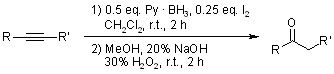
Activated pyridine borane complexes (Py·BH2X) are capable of
hydroborating alkenes at room temperature. An unusual hydroboration
mechanism is discussed. Hydroboration of alkynes with Py·BH2I
selectively affords the monoadducts. The preparation of synthetically useful
potassium alkyltrifluoroborate salts is described.
J. M. Clay, E. Vedejs, J. Am. Chem. Soc.,
2005, 127, 5766-5767.

Sodium perborate: a mild and convenient reagent for efficiently oxidizing
organoboranes
G. W. Kabalka, T. M. Shoup, N. M. Goudgaon, J. Org. Chem., 1989, 5930-5933.

A phosphorous acid promoted alkyne-aldehyde hydration-condensation enables a
simple and environmentally benign synthesis of chalcones in high to excellent
yields in an oil/water two-phase system.
Y. Zhou, Z. Li, X. Yang, X. Chen, M. Li, T. Chen, S.-F. Yin,
Synthesis, 2016, 48, 231-237.

A gold-catalyzed hydroamination of propargylic
alcohols with anilines provides 3-hydroxyimines. A subsequent reduction gives
1,3-amino alcohols with high syn selectivity. By using a
catalytic amount of aniline, 3-hydroxyketones can be obtained in high yield
directly from propargylic alcohols. And a selective formation of 3-aminoketones via a rearrangement/hydroamination
pathway is also described.
V. Laserna, M. J. Porter, T. D. Sheppard, J. Org. Chem., 2019,
84, 11391-11406.

A catalyst comprising of Ph3PAuCl and AgSbF6 efficiently
hydrolyzes terminal alkyne groups of propargyl acetates in the absence of acid
promoters at ambient temperature within a short time. Effective regioselective
hydration is facilitated by the neighboring carbonyl group. Synthesis of
actinopolymorphol B is achieved involving hydration of the propargyl acetate as
the key step.
N. Ghosh, S. Nayak, A. K. Sahoo, J. Org. Chem., 2011,
76, 500-511.

A mild, atom-economical, Au(III)-catalyzed hydration of 3-alkynoates allows a
practical one-step synthesis of a wide range of γ-keto esters in good yields,
through a carbonyl group participation enabled by a favored 5-endo-dig
cyclization.
W. Wang, B. Xu, G. B. Hammond, J. Org. Chem., 2009,
74, 1640-1643.

Gold-catalyzed intermolecular oxidation enables an efficient conversion of
various terminal alkynes into the corresponding α-acetoxy ketones in the
presence of 8-methylquinoline 1-oxide as the oxidant. The reaction probably
proceeds through an α-oxo gold carbene intermolecular O-H insertion.
C. Wu, Z. Liang, D. Yan, W. He, J. Xiang, Synthesis, 2013, 45,
2605-2611.

An efficient, indirect anti-Markovnikov hydration of unsymmetrically substituted
terminal and internal alkynes is based on TiCl4-catalyzed
hydroamination reactions. Its application to ortho-alkynylhaloarenes,
followed by a copper-catalyzed O-arylation, provides substituted
benzo[b]furans.
L. Ackermann, L. T. Kaspar, J. Org. Chem., 2007,
72, 6149-6153.

Cyclopentanone as an electron pair donor proved highly efficient for the
stabilization of allyl and vinyl cations in combination with a calcium-based
catalyst system. The system enabled a transition-metal-free intermolecular
carbohydroxylation of alkynes with allyl and propargyl alcohols.
T. Stopka, M. Niggemann, Org. Lett.,
2015,
17, 1437-1440.

Au-catalyzed hydration of haloalkynes enables an atom-economical synthesis of a
wide range of α-halomethyl ketones as an alternative to conventional
α-halogenation of ketones. Other outstanding features include excellent yields
from both alkyl- and aryl-substituted haloalkynes and wide functional group
tolerance.
L. Xie, Y. Wu, W. Yi, L. Zhu, J. Xiang, W. He, J. Org. Chem., 2013,
78, 9190-9191.

An electrochemical oxydihalogenation of alkynes enables the preparation of
α,α-dihaloketones using CHCl3, CH2Cl2, ClCH2CH2Cl,
and CH2Br2 as the halogen source at room temperature.
X. Meng, Y. Zhang, J. Luo, F. Wang, X. Cao, S. Huang,
Org. Lett., 2020, 22, 1169-1174.

A very rapid and efficient method enables a one-pot synthesis of
α,α-dibromoalkanones and β-bromoenol alkanoates directly from alkynes using
N,N-dibromo-p-toluenesulfonamide. The protocol offers ambient temperature,
high regioselectivity, operational simplicity, and metal- and catalyst-free
conditions.
R. Chawla, A. K. Singh, L. D. S. Yadav, Synlett, 2013, 24,
1558-1562.

A ruthenium-catalyzed hydrative cyclization converts a range of 1,5-enynes
bearing terminal alkyne and Michael acceptor moieties into cyclopentanone
derivatives.
Y. Chen, D. M. Ho, C. Lee, J. Am. Chem. Soc.,
2005, 127, 12184-12185.

An expedient and reliable method for accessing reactive α-oxo gold carbenes via
gold-catalyzed intermolecular oxidation of terminal alkynes offers a safe and
economical alternative to strategies based on diazo substrates. Its synthetic
potential is demonstrated by expedient preparation of dihydrofuran-3-ones
containing a broad range of functional groups.
L. Ye, L. Cui, G. Zhang, L. Zhang, J. Am. Chem. Soc., 2010,
132, 3258-3259.

A regioselective gold-catalyzed hydration of CF3- and SF5-alkynes
provides the corresponding trifluoromethylated and pentasulfanylated ketones in
good yield as single regioisomers. CF3 and SF5 serve as
highly efficient directing groups.
M. Cloutier, M. Roudias, J.-F. Paquin,
Org. Lett., 2019, 21, 3866-3870.

Photoredox catalysis enables a direct oxidative addition of CF3 and H2O
to alkynes to provide α-trifluoromethyl ketones via rapid enol-keto
tautomerization. The reaction exhibits high functional group tolerance and
regioselectivity. In addition, trifluoromethylated heterocycles of various sizes
were synthesized from α-CF3-substituted diketones.
Y. R. Malpani, B. K. Biswas, H. S. Han, Y.-S. Jung, S. B. Han, Org. Lett.,
2018, 20, 1693-1697.

Graphitic carbon nitride (p-g-C3N4) photocatalyzes a
hydrosulfonylation of alkynes with the insertion of sulfur dioxide in aerobic
conditions. Whereas the oxygen atom of the products is derviced from water, the
O2 plays an important role by quenching the DABCO radical cation.
Furthermore, this reaction could be carried out under solar light irradiation
and was applicable for large scale.
B. Ni, B. Zhang, J. Han, B. Peng, Y. Shan, T. Niu,
Org. Lett., 2020, 22, 636-641.
Related

A formic acid promoted hydration of readily available alkynes followed by an
iridium-catalyzed transfer hydrogenation under mild conditions provides
alcohols. This transformation is simple, efficient, and can be performed with a
variety of alkynes in good yields and with excellent stereoselectivities.
N. Luo, Y. Zhong, J.-T. Liu, L. Ouyang, R. Luo, Synthesis, 2020, 52,
3439-3445.

Triflate salts of several transition metal catalysts greatly faciliate the
conversion of alkynes to their corresponding vinyl triflates. Products are
formed in high regioselectivity under mild conditions most especially using
Zn(OTf)2. Internal alkynes bearing an aryl substituent afford vinyl
triflates with a modest preference for the Z-isomer. A mechanism explains the
unique role of silicon in this system.
M. H. Al-huniti, S. D. Lepore, Org. Lett.,
2014,
16, 4154-4157.

Ruthenium complexes were successfully applied in highly regioselective
Markovnikov additions of carboxylic acids to terminal alkynes, yielding valuable
enol esters. Selectivity and activity could be further improved by the addition
of catalytic amounts of AgOTf. A broad range of simple as well as electronically
or sterically challenging substrates could be isolated in good to excellent
yields with high regioselectivity and under mild reaction conditions.
J. Jeschke, C. Gäbler, H. Lang, J. Org. Chem.,
2016,
81, 476-484.

A cobalt-catalyzed highly regio- and stereoselective hydro-oxycarbonylation
of terminal and internal alkynes with carboxylic acids provides enol esters in
high yields. A catalyst in situ generated from Co(BF4)2, a
tridentate phosphine ligand, and zinc exhibits a higher reactivity than the
corresponding cobalt/diphosphine complex.
J.-F. Chen, C. Li, Org. Lett.,
2018, 20, 6719-6724.

A rhodium-catalyzed, selective intermolecular anti-Markovnikov addition
of carboxylic acids to terminal alkynes gives valuable Z-enol esters. The
catalyst system is applicable to a broad substrate scope and displays a wide
functional group tolerance.
A. Lumbroso, N. R. Vautravers, B. Breit, Org. Lett., 2010,
12, 5498-5501.

PPh3AuCl/AgPF6-catalyzed hydroacyloxylation of alkynes
with carboxylic acids affords the Markonikov addition products, whereas PPh3AuCl/AgOTf
catalyst gives the more stable isomerized products via the Markonikov products.
B. C. Chary, S. Kim, J. Org. Chem., 2010,
75, 7928-7931.