Ionic Liquids
 A solidified ionic
liquid1)
A solidified ionic
liquid1)
An ionic liquid is a salt in which the ions are poorly coordinated, which results in these solvents being liquid below 100°C, or even at room temperature (room temperature ionic liquids, RTIL's). At least one ion has a delocalized charge and one component is organic, which prevents the formation of a stable crystal lattice.
The methylimidazolium and pyridinium ions have proven to be good starting points for the development of ionic liquids:
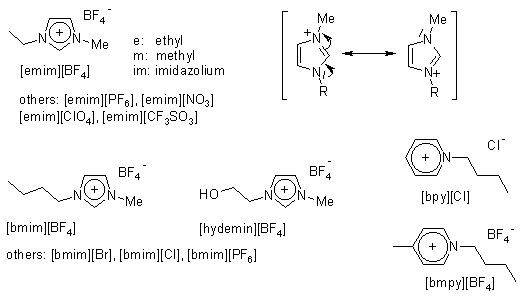
Properties, such as melting point, viscosity, and solubility of starting materials and other solvents, are determined by the substituents on the organic component and by the counterion. Many ionic liquids have even been developed for specific synthetic problems. For this reason, ionic liquids have been termed "designer solvents".
One of the first RTILs was a mixture of [emim]Cl with AlCl3 forming a series of equilibria between [emim][AlCl4], [emim][Al2Cl7], and [emim][Al3Cl10]. This RTIL is not water stable. The discovery of water-insoluble RTILs such as [bmim][PF6] allowed the development of new work-up methods, including the separation of water-soluble byproducts by simple extraction. Some transition metal catalysts that are soluble in ionic liquids may be recycled together with the ionic liquid, after extraction with water and the non-polar organic solvent used for product separation. The catalyst and ionic liquid may be recycled several times.
In addition, the following RTIL, derived from fructose (a renewable feedstock), is a promising solvent for implementing fully "green chemistry" methods:

S. T. Handy, M. Okello, G. Dickenson, Org. Lett., 2003, 5,
2513-2515.
This ionic liquid was proven to be suitable for Heck Reactions:

S. T. Handy, M. Okello, G. Dickenson, Org. Lett., 2003, 5,
2513-2515.
The absence of volatility is one of the most important benefits of ionic liquids, offering a much lower toxicity as compared to low-boiling-point solvents. Ionic liquids can also make for safer microwave synthesis methods, because sudden pressure surges are not possible. The dipole characteristics of ionic liquids translate into rapid excitation by microwaves, and consequently faster reactions.
Reviews on Ionic Liquids
P. Wasserscheid, W. Keim, Angew. Chem. Int. Ed. Engl. 2000 , 39, 3772. DOI
Books on Ionic Liquids

Ionic Liquids in Synthesis
Peter Wasserscheid, Tom Welton
Hardcover, 364 Pages
First Edition, November 2002
ISBN: 3-527-30515-7 - Wiley-VCH

Chemistry in Alternative Reaction Media
D. J. Adams, P. J. Dyson, S. J. Taverner
Paperback, 268 Pages
First Edition, November 2003
ISBN: 0-471-49849-1 - Wiley
Recent Literature

A series of 1-alkoxy-3-methyl- and 3,4-dimethyl-3-phospholene 1-oxides, as well
as 1-alkoxy-3-methylphospholane 1-oxides were prepared in good yields by a
microwave-assisted and [bmim][PF6]-catalyzed transesterification of
the corresponding methyl or ethyl esters.
N. Harsági, N. Z. Kiss, L. Drahos, G. Keglevich, Synthesis, 2022, 54,
3899-3905.

Using bis(trimethylsilyl) peroxide as the oxidant and simply exchanging
dichloromethane, the classical solvent for Baeyer-Villiger oxidation, for the
ionic liquid bmimNTf2, results in increased product yields.
1-Butyl-3-methylimidazolium trifluoromethanesulfonate can replace both the
solvent and BF3·OEt2
as catalyst. This method gives lactones in high yields with the possibility of
ionic liquid recycling.
S. Baj, A. Chrobok, R. Słupska, Green Chem., 2009,
11, 279-282.

A recyclable ionic liquid supported organotelluride catalyzes an aerobic
oxidation of phosphite esters to phosphate esters. This method offers high
conversion rates and allows a ready isolation of the resulting products. The
catalyst can be reused.
A. Mihoya, Y. Shibuya, A. Ito, A. Toyoda, M. Oba, S. Koguchi Synlett, 2020,
31,
2043-2045.

Alcohols were efficiently converted to alkyl halides using 1-n-butyl-3-methylylimidazolium
halide ioniq liquids in the presence of Brønsted acids at room temperature. The
alkyl halide products were easily isolated from the reaction mixture via simple
decantation or extraction.
R. X. Ren, J. X. Wu, Org. Lett., 2001, 3,
3727-3728.

A sulfoxide reduction/C-S bond metathesis cascade between sulfoxides and
alkyl bromides in an ionic liquid provides high-value sulfides without the use
of any catalysts or bases. In this cascade, classical Kornblum oxidation is
employed to reduce sulfoxides with alkyl bromides. This protocol features high
functional tolerance, mild conditions, promising scalability, and a sustainable
solvent.
C. Liu, D. Chen, Y. Fu, F. Wang, J. Luo, S. Huang,
Org. Lett., 2020, 22, 5701-5705.

Stereoselective halogenations of alkenes and alkynes can be conducted in
room-temperature ionic liquids, 1-butyl-3-methylimidazolium hexafluorophosphate,
1-butyl-3-methylimidazolium tetrafluoroborate, 1-butyl-3-methylimidazolium
bromide, and 1-butyl-3-methylimidazolium chloride as "green" recyclable
alternatives to chlorinated solvents.
C. Chiappe, D. Capraro, V. Conte, D. Pieraccini,
Org. Lett., 2001, 3, 1061-1063.

A simple microwave-accelerated condensation of 2-aminothiophenol and aromatic
aldehyde in an inexpensive ionic liquid, 1-pentyl-3-methylimidazolium bromide ([pmIm]Br)
provides 2-arylbenzothiazoles under solvent and catalyst-free condition. The
ionic liquid can be recycled for subsequent reactions.
B. C. Ranu, R. Jana, S. S. Dey, Chem. Lett., 2004,
286-287.

Hydrogen peroxide as an eco-friendly oxidant provides hydroxylation products
of arylboronic acids in an efficient manner under metal- and base-free aerobic
in the presence of a room-temperature ionic liquid (RTIL).
E.-J. Shin, G.-T. Kown, S.-H. Kim, Synlett, 2019,
30,
1815-1819.

The ionic liquid 1,3-disulfonic acid imidazolium nitrate {[Dsim]NO3}
can be used as nitrating agent for the ipso-nitration of various
arylboronic acids and nitro-Hunsdiecker reaction of different α,β-unsaturated
acids and benzoic acid derivatives to give various nitroarenes and nitroolefins
without using any cocatalysts and solvents under mild conditions.
M. Zarei, E. Noroozizadeh, A. R. Moosavi-Zare, M. A. Zolfigol, J. Org. Chem., 2018, 83,
3645-3650.

The choline- and peroxydisulfate-based environmentally benign biodegradable
oxidizing task-specific ionic liquid (TSIL) choline peroxydisulfate (ChPS) was
synthesized and characterized. This reagent enables a selective oxidation of
alcohols to aldehydes/ketones in very good yields and short reaction time under
solvent-free mild reaction conditions without overoxidation to acid.
B. L. Gadilohar, H. S. Kumbhar, G. S. Shankarling, Ind. Eng. Chem. Res., 2014,
53, 19010-19018.

Choline peroxydisulfate - an oxidizing task-specific ionic liquid - enables the
preparation of N,N-disubstituted hydroxylamines from secondary amines. This
method offers operational simplicity, high selectivity, and green reaction
conditions.
A. Banan, H. Valizadeh, A. Heydari, A. Moghimi,
Synlett, 2017, 28, 2315-2319.

A pyrene-substituted imidazolium-based ionic liquid (PIL) serves as organic
catalyst for the SN2 fluorination using CsF. In this system, the PIL
significantly enhanced the reactivity of the metal fluoride due to the
phase-transfer catalytic effect of the imidazolium moiety as well as the metal
cation-π (pyrene) interactions. Furthermore, PIL can easily be separated from
the reaction mixture using reduced graphene oxide by π-π stacking.
A. Taher, K. C. Lee, H. J. Han, D. W. Kim, Org. Lett.,
2017, 19, 3342-3345.

The Brønsted acidic ionic liquid [Dsim]Cl (1,3-disulfonic acid imidazolium
chloride) enables the sulfonation of aromatic compounds via in situ generation
of sulfuric acid at 50°C under mild aqueous conditions.
A. R. Moosavi-Zare, M. A. Zolfigol, E. Noroozizadeh,
Synlett, 2016, 27, 1682-1684.

Use of the powerful Lewis acid, iron(III) triflimide, generated in situ from
iron(III) chloride and a readily available triflimide-based ionic liquid allowed
activation of N-iodosuccinimide (NIS) and efficient iodination of a wide
range of arenes under mild conditions.
D. T. Racys, C. E. Warrilow, S. L. Pimlott, A. Sutherland, Org. Lett.,
2015,
17, 4782-4785.

An 1,4-diazobicyclo[2.2.2]octane (DABCO) based ionic liquids were used as
recyclable catalysts for the aza-Michael addition at room temperature without
any organic solvent. A low loading of the very efficient [DABCO-PDO][OAc]
catalyzed reactions of various amines with a wide range of α,β-unsaturated
amides to afford products in very good yields within hours. Moreover, the
catalyst could be reused up to eight times.
A. Ying, Z. Li, J. Yang, S. Liu, S. Xu, H. Yan, C. Wu, J. Org. Chem., 2014,
79, 6510-6516.

An efficient cross-coupling reaction of aryl/het-aryl/benzyl halides with stable
and easily workable sulfonyl hydrazides as thiol substitutes delivers
unsymmetrical sulfides in the presence [DBU][HOAc] and CuI under microwave
irradiation.
N. Singh, R. Singh, D. S. Raghuvanshi, K. N. Singh, Org. Lett., 2013,
15, 5874-5877.

A convenient and practical method for the one-pot, three-component synthesis of
terminal vinylphosphonates from aldehydes, nitromethane and trialkylphosphites
through a tandem Henry-Michael reaction followed by nitro elimination in the
presence of 5-hydroxypentylammonium acetate (5-HPAA) as a task-specific ionic
liquid offers good yields of the products under mild reaction conditions.
S. Sobhani, M. Honarmand, Synlett, 2013, 24,
236-240.

Ionic liquids [bmim][X] (X = Cl, Br, I, OAc, SCN) are highly efficient reagents
for nucleophilic substitution reactions of sulfonate esters derived from primary
and secondary alcohols. The newly developed protocol is very environmentally
attractive because the reactions use stoichiometric amounts of ionic liquids as
sole reagents without additional solvents and activating reagents. Moreover,
these ionic liquids can be readily recycled.
Y. Liu, Y. Xu, S. H. Jung, J. Chae, Synlett, 2012, 23,
2663-2666.

Triflyl nitrate (TfONO2) and trifluoroacetyl nitrate (CF3CO2NO2),
generated via metathesis in the readily available ethylammonium nitrate (EAN)
ionic liquid as solvent, are powerful electrophilic nitrating reagents for a
wide variety of aromatic and heteroaromatic compounds. Comparative nitration
experiments indicate that EAN/Tf2O is superior to EAN/TFAA for
nitration of strongly deactivated systems.
G. Aridoss, K. K. Laali, J. Org. Chem., 2011,
76, 8088-8094.

A straightforward and efficient Yb(OTf)3 catalyzed three-component
reaction of aldehydes, alkynes, and amines under microwave irradiation in an
ionic liquid provides 2,4-disubstituted quinolines in excellent yield under mild
reaction condition. The catalyst can be recycled up to four times.
A. Kumar, V. K. Rao, Synlett, 2011,
2157-2162.

1-Alkyl-3-methylimidazolium cation based ionic liquids efficiently catalyze
N-tert-butyloxycarbonylation of amines with excellent chemoselectivity. The
catalytic role of the ionic liquid is envisaged as electrophilic activation of
di-tert-butyl dicarbonate (Boc2O) through bifurcated hydrogen
bond formation with the C-2 hydrogen of the 1-alkyl-3-methylimidazolium cation.
A. Sarkar, S. R. Roy, N. Parikh, A. K. Chakraborti, J. Org. Chem., 2011,
76, 7132-7140.
Please cite and link this page as follows:
Ionic Liquids ( URL: https://www.organic-chemistry.org/topics/ionic-liquids.shtm )
1) source: Prof. Gmehling, Oldenburg